
The Defeat and Attrition Of The 12. SS-PanzerDivision HitlerJugend
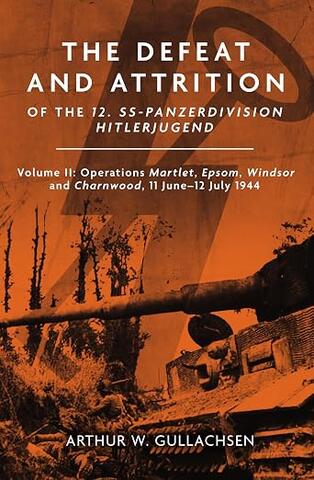
Arthur W. Gullachsen's work again graces our pages in this latest review. Here we cover Gullachsen's second volume in his detailed look at the combat operations of the 12. SS-PanzerDivision during June and July of 1944 in response to the Allied invasion of Normandy, France. The Defeat and Attrition Of The 12. SS-PanzerDivision HitlerJugend Volume II adds much to our understanding of the armor-heavy battles on the eastern end of the Allied lodgement in Normany in picking up where Volume I left off. I recommend it for anyone interested in armored warfare.
The focus here is on the 12. SS-PanzerDivision in its defensive role against the onslaught of British-Canadian forces on the eastern end of the Normandy lodgement just north and west of Caen. More specifically, events covered include the fighting between 11 June and 12 July: the Cristot triangle; the Parc de Boislonde; Fontenay-le-Pesnel; Operation Epsom and the main events of the Battle of the Odon; Operation Windsor and the attack on Carpiquet airfield; and the Anglo-Canadian assault on Caen, Operation Charnwood. Also described is the infamous clash at Villers-Bocage; with the author offering his own much appreciated analysis of that fighting's impact on the larger campaign.
Volume II in this series amply details how the Germans wasted the considerable combined-arms striking power of the 12. SS-PanzerDivision, allowing it to be ground down under the sheer firepower of the British Second Army's methodical advance toward Caen. The German operational and strategic level leadership comes in for much due harsh criticism from Gullachsen, while the bravery of the British and Canadian troops as well as the impressive effectiveness of the British-Canadian artillery is highlighted in these pages. These are important books, doing much to correct lingering perceptions in the U.S. in particular that their British and Canadian Allies underperformed during the Normandy campaign when in reality they were forced to fight against the strongest German divisions then in existence (who fought well in spite of the poor higher-level leadership they fought under).
The maps are numerous, well-placed, and prepared. They do much to help the reader visualize the deployments of the respective combatants. In addition, numerous photographs are provided to offer further illustration of the weaponry, locations, and troops involved in the fight. Finally, the book features a detailed set of appendices covering important details related to the fighting - not least of which in documenting German armored losses during these battles. This is a valuable book that very much adds to our understanding of these crucial Second World War events and why the Germans ultimately lost this campaign.


Post new comment