
Why Barbarossa Failed
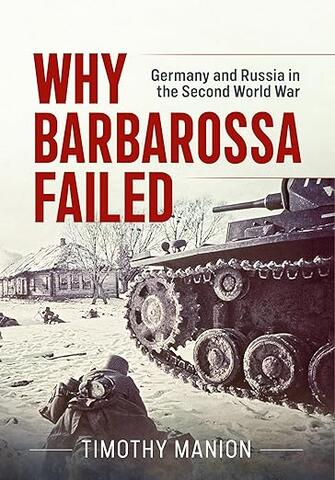
I just finished Why Barbarossa Failed by Timothy Manion, and thoroughly enjoyed it. The analysis is superbly done. I was happy to see that many of it's conclusions complement mine as to the reasons underlying the outcome of the 1941 German campaign against the Soviet Union. I was equally delighted to find many other conclusions that run counter to mine, but which are so well supported that even though I may disagree with some of them - they nevertheless provided much food for thought. So much so, I have found myself going back and revisiting different sections of the book on multiple occasions; even though I finished my initial read a week ago.
Given the immense number of publications in existence devoted toward answering the question as to why Operation Barbarossa failed, one might think another book on this subject wouldn't have much to offer. Such a thought would be incorrect. This is particularly true because the vast majority of historical output over the past eighty plus years has argued that Nazi Germany’s June 1941 invasion of the Soviet Union was doomed from the outset due primarily to the sheer size of the Soviet Union, the enormous numerical advantages in men and war material it possessed, the difficult weather conditions in its vast spaces, poor infrastructure, and the German war machine's own alleged weaknesses in logistics and staying power. The most notable proponent of such concepts in recent years is the regressive historian David Stahel.
In Why Barbarossa Failed Manion masterfully challenges that conventional wisdom. He provides a thoroughly researched and aggressively argued analysis of this widely studied campaign to find far more important reasons exist to explain German defeat. To that point, Manion grounds his evidence in a deeper study of the evolution in military theory and military doctrine that took place in Europe during the prior century plus of conflict that led up to the Nazi-Soviet war.
This is a deeply researched book that relies upon a number of impeccable archival and secondary sources to explain the doctrine, organization, and sources of both strengths and weaknesses of both the Wehrmacht and Red Army. The results of this effort are conclusions well fortified to bury the conventional wisdom as to the how and why of German defeat during Barbarossa, with a particular focus on the central role played by German failings of generalship and leadership in that defeat. It is to my regret that I was not able to review Manion's work last year, and thus cite to and give further attention to several of his key conclusions as part of my own three volume set (to be published by Pen & Sword books later this year) focused on Germany's 1941-1942 campaigns in the Ukraine and Southern Russia. Alas, they say timing is everything; and with Manion's work only published recently and my final drafts turned over to my publisher late in 2025 it was not to be. Nevertheless, I am thrilled to see there is both some congruence between our findings (and much of difference that can be debated further) in our respective and different works.
There is one note of caution directed toward the general military enthusiast regarding Manion's superb scholarship. Unlike my forthcoming works (and my previous book - all of which written to form a bridge between the scholarly and popular non-fiction world), Why Barbarossa Failed is squarely targeted at the advanced student of military theory and operations. This is a book that is meant to be enjoyed and argued over in the world's leading centers of military research and study. Though it does a great job of explaining the foundational ideas of several of the world's foremost military theorists from the past two plus centuries, the fact such discussions are frequently engaged in and cited to is a tell as to the level of prior knowledge one should have to get the most from this book.
That is not to say a more general enthusiast of the Nazi-Soviet war won't find this book enjoyable. They will, even if it might require they do a bit of research of their own as they read and are possibly confronted with ideas and theorists they may not have previously known. In fact, the general reader perhaps should tackle this book if for no other reason than it represents such a clear shot across the bow of an otherwise stale and outdated consensus that still inexplicably finds itself being peddled by those such as Stahel and his ilk. Moreover, Manion takes pains to make these concepts more approachable. The book is broken down into smaller sections, and there are a number of figures, maps, and appendices that do much to help explain his most notable findings. Given that, I very much recommend this book to all of my readers. It should be found on the bookshelf of any serious student of the 1941-1945 war fought between Nazi Germany and the Soviet Union.


Post new comment