
German WW2 Zugkraftwagen Half-Track Tractors
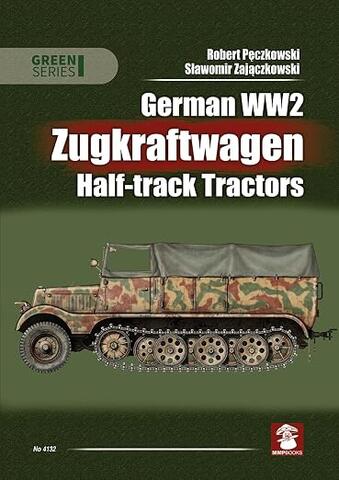
German WW2 Zugkraftwagen offers crucial insight into an often ignored but vital aspect underlying combat efficacy on the mechanized battlefields of World War II. Though short, at 72 pages (but favorably priced to match, as it can be had for roughly the same cost as a sit-down lunch for one person) - this book packs quite a bit of information and imagery into its pages. Moreover, it helps further flesh out why panzer divisions (where mechanized half-tracks were overwhelmingly assigned) were such effective fighting formations.
German Zugkraftwagen of the Second World War were military half-track vehicles (designated by the Germans as Sonderkraftfahrzeug, or Sd.Kfz. in their various permutations). They provided incredible off-road mobility due to their wheeled steering coupled with a long body powered by tracks instead of wheels that together provided superb torque and pulling ability (even through mud or snow). The U.S. and German army embraced such vehicles more than any of their Second World War peers. Nevertheless, the Germans were unique in the sheer variety of roles and purposes around which they designed and deployed their half-tracks.
If one is to understand the strengths and weaknesses of the Wehrmact (German armed forces), then it is essential to learn how these machines were developed and used. German WW2 Zugkraftwagen does exactly that. It is filled with illustrations paired with detailed captions explaining exactly what is being pictured in terms of the primary German half-track vehicles. Each of the main models featured includes ample attention to its development, technical data, differences between models and how such vehicles as the Sd. Kfz. 6, Sd.Kfz. 7, Sd.Kfz. 8, Sd. Kfz. 9, Sd.Kfz. 10 and Sd.Kfz. 11 were employed. The archival pictures are in black and white, but the book also features gorgeous color profiles of each vehicle in various roles during different seasons and on the wide range of fronts where they worked. In addition, there is accompanying text further fleshing out each vehicle's production history and variants.
Though this book is a veritable gold-mine for modellers (even detailing the wide variety of paint schemes employed and comparative views of each vehicle from the front and back, road wheel comparisons, and size comparisons), it also offers much for those interested in Second World War armored vehicles.


Post new comment