Skip directly to content

Blog

nothing
Submitted by
Steve Mercatante
on: Nov 18 2011 - 5:30pm

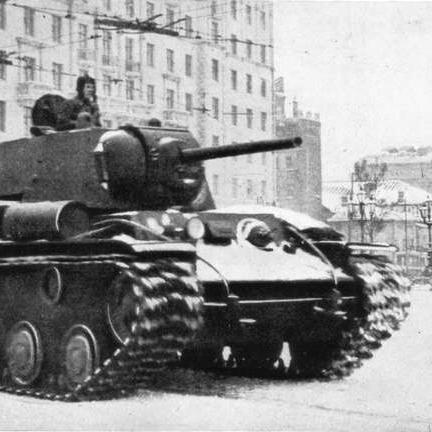
Russian soldiers of the 90th Special Search Battalion of the Western Military District, along with staff from the Museum of the Battle for Leningrad, have recovered a KV-1 tank from the Neva River near Leningrad. Thankfully no crew remains were found, thus meaning they likely escaped, and the tank itself is in relatively good condition. It is expected the tank will be able to be fully restored and be used in parades as a living historical artifact.

The KV-1 was the primary heavy tank in the
nothing
Submitted by
Steve Mercatante
on: Nov 15 2011 - 5:43pm

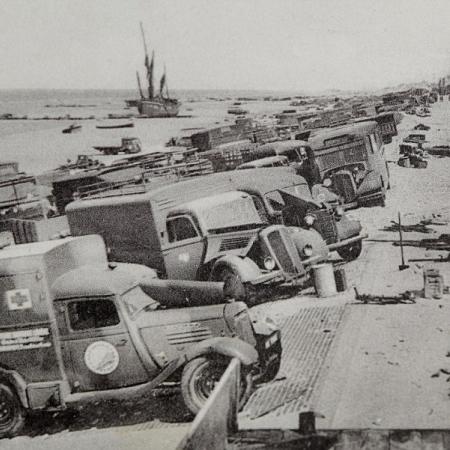
A slew of new pictures of the often forgotten dark side of the Dunkirk rescue operation, taken by a German soldier after the battle, provide chilling evidence of the scope of the disaster suffered by Allied forces following the German invasion of Western Europe in May, 1940.

Within ten day of the German invasion, tanks from the 2nd Panzer Division had crossed the Somme River and reached the English Channel at Abbeville, completing the encirclement of approximately 1.7 million British, French,

nothing
Submitted by
Steve Mercatante
on: Nov 11 2011 - 2:46pm

On May 13, 1938 an Act of Congress established Armistice Day as a national holiday, following up on President Woodrow Wilson's November 11, 1919 proclamation of the first Armistice Day honoring American veterans who fought in WWI. Though WWI did not formally end until the Treay of Versailles was signed on June 28, 1919; in the US, Armistice Day, with the armistice marking the temporary end of combat on November 11, 1918, is widely regarded as the end of the First World War.

Review Type: Armistice, Veteran, WWI
nothing
Submitted by
Steve Mercatante
on: Nov 11 2011 - 2:09pm

Today the United States Marine Corps celebrates 236 years of protecting US interests abroad.

nothing
Submitted by
Steve Mercatante
on: Nov 8 2011 - 3:04pm

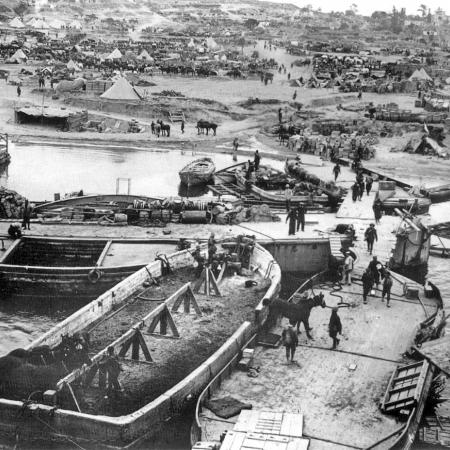
In April of 1915 soldiers from the British Army and Commonwealth, including the Australia-New Zealand Army Corps, and French Army and Empire, landed on the Gallipoli penninsula in an effort to open the route to Russia and seize Constantinople. There they faced Turkish troops from the Ottoman Empire in a brutal campaign fought in rugged terrain featuring extensive trench systems separated at certain points by as few as 10 to 20 yards. An ongoing archaeological survey has uncovered not only

nothing
Submitted by
Steve Mercatante
on: Nov 6 2011 - 4:11pm

World War II is widely rememberd as the most expensive war ever fought by the United States. In constant dollars, World War II's portion of our nation's GDP reached 35.8% at its height, and ultimately cost a staggering $4.1 trillion in FY2011 dollars. Many have long thought that, short of a feared WWIII, it would hardly be likely that today's unconventional wars could approach such costs.

nothing
Submitted by
Steve Mercatante
on: Nov 4 2011 - 9:45pm

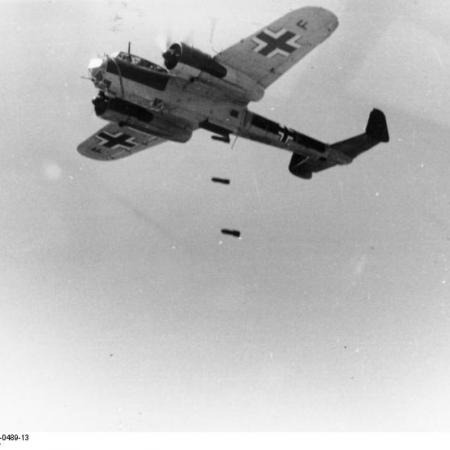
Lying underwater in the English Channel off the coast of Kent, United Kingdom is the world's last known surviving Do-17 bomber. In a joint attempt the Royal Air Force Museum and Imperial College of London are attempting to salvage the well preserved Do-17 - found in 2010 after sands shifted that had previously hidden the bomber, and have now left it exposed to seawater that can corrode the aircraft very quickly.

nothing
Submitted by
Steve Mercatante
on: Nov 1 2011 - 4:38pm

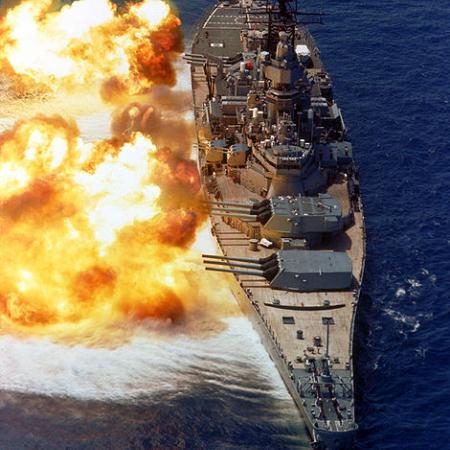
Late last week the USS Iowa (BB-61), the lead ship in the final class of US battleships ever built, began a voyage from Suisun Bay, California that will ultimately end in Los Angeles - where she will serve as a floating museum.

Laid down in June 1940 and commissioned in February 1943 the Iowa weighed in at 45,000 tons, was 887 feet long and included a crew of over 2,750 officers and men.

nothing
Submitted by
Steve Mercatante
on: Oct 29 2011 - 12:56pm

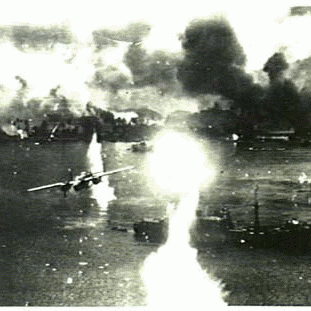
Australian and New Zealand warships clearing World War II era munitions from the harbor at Rabaul have found what is believed to be a Japanese midget submarine. The wreck was found sitting upright on the sandy bottom at 180 feet underwater. Rabaul was one of the most important Japanese Naval bases during the War, and the site of sharp combat in January 1942 - when Japanese forces seized the harbor and associated military installations from Australian forces.

nothing
Submitted by
Steve Mercatante
on: Oct 28 2011 - 2:57pm

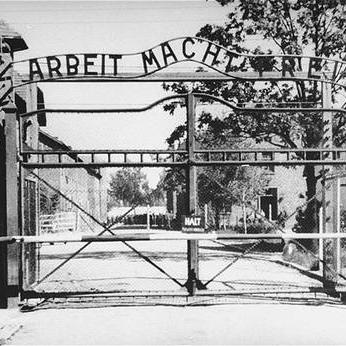
Polish authorities have ordered a new investigation into the crimes against humanity committed at the Auschwitz concentration camp during World War II. The Germans murdered an estimated 1.5 million people at Auschwitz, located near Krakow, until the Red Army libereated the camp late in January 1945. 

The crimes committed at Auschwitz were central to Nazi Germany's plans to create lebensraum in Eastern Europe - to be done mostly at the expense of the Slavic and Jewish people, though hundreds of

Pages